
Small businesses still get found mostly through Google, but fewer of those searches now end in a click because the answer often sits on the results page itself. AI assistants send a much smaller share of visits, at unusually high intent. Both reward the same material: specific, current, properly sourced pages.
What changed
Three things. Only one of them is the thing everyone talks about.
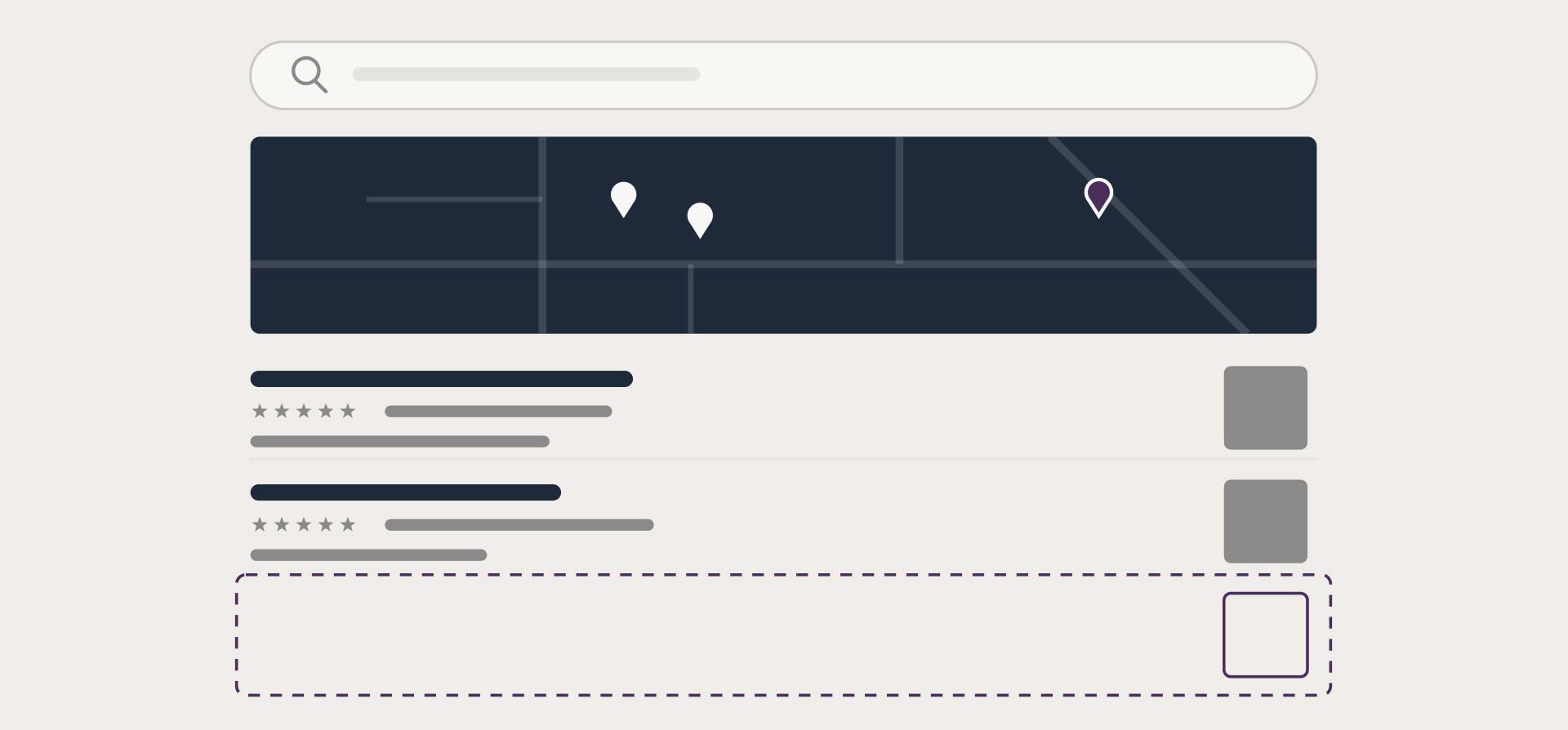
The first is that a search result now often arrives with the answer attached. Ofcom puts AI Overviews on around 30% of UK searches, and 53% of adults say they see them often. The person reads the summary, and that’s the end of the visit. They never reach you.
The second is that a small but real group of people have stopped starting at Google. The scale of that shift is easy to overstate, so here are both halves of it. Google Search is used by 82% of UK adults and handles roughly 3 billion searches a month, while ChatGPT recorded 1.8 billion UK visits across the first eight months of 2025, against 368 million over the same period in 2024 (Ofcom, Online Nation 2025, 10 December 2025). Google is still miles ahead. ChatGPT grew nearly fivefold in a year. If somebody does land on your site from an assistant, they tend to arrive most of the way to a decision.
The third gets the least attention and matters most if you employ fewer than twenty people. Most of what gets you into an AI answer is what got you ranking in the first place. A site that can be crawled, pages that load, a clear subject, a named author who demonstrably exists. The foundations don’t fork.
The differences are narrower than the acronyms suggest. Google published its own guidance on this in July 2026 and the position is blunt: optimising for generative AI search, it says, is optimising for the search experience. Still SEO, in other words. The same document lists what you can safely ignore, and it turns out to be most of what’s currently being sold as AI Optimisation. No llms.txt file. No chopping your pages into small chunks for the machines. No chasing mentions on other people’s sites. No rewriting your copy in some special AI-friendly register.
What the guidance does explain is how the answers get assembled, and that part matters. Two mechanisms do the work. Grounding, also called retrieval-augmented generation, means the system pulls pages out of the ordinary search index and writes its answer from what it finds in them. Query fan-out means the model quietly runs a handful of related searches alongside the one you typed, so a question about a lawn full of weeds also becomes searches about herbicides and weed prevention. The practical effect is that you’re no longer competing for a single phrase. You’re being assessed against a cluster of questions you never saw, which is why one page that covers a subject properly tends to beat five thin ones that each take a slice of it.
So, optimising for AI isn’t necessarily a second specific discipline. It’s the same work, marked more strictly, with a handful of extra checks at the end that most people aren’t doing yet.
One more thing has changed since the start of the year, which is that you can finally see some of this in your own analytics. I’ll come to that.
If you read one section here, read the one on what to do. Everything before it is the evidence for it.
Is SEO still worth it for a small business?
Yes, but the return has moved. Expect fewer visits from the same organic ranking positions, and better quality visits from the ones you are getting. Judge the work on enquiries and lead quality, rather than sessions from organic search referrals in isolation.
The uncomfortable part of that is the number you’ve been reporting on for years is going to get worse, while the number that pays the wages doesn’t.
Search is still where the money goes. UK digital ad spend hit £40.5bn in 2025, a 10% rise against GDP growth of 1.4% and search alone was 44% of it. That’s a census of UK media owners rather than a panel estimate, which makes it the most solid number in this article. Industries this size don’t quietly stop working in eighteen months.
What has genuinely changed is the yield per search. A page ranking third for a phrase nobody is typing into Google was never worth much and, unsurprisingly, it’s worth even less now. A page that fully answers a real buying question, for the fifty or so people who search Google for it, is arguably worth more today than it was two years ago.
That points the work somewhere more useful. Before asking whether search still pays, work out which of your pages ever did. On most small business websites it’s usually just a handful, with the rest existing because somebody once exported a keyword list and turned every row into a page.
What happens to your clicks when an AI answer sits above the results?
Roughly half of them go. Pew’s browsing data found people clicked an organic result 8% of the time when an AI Overview was present, against 15% when it wasn’t.
That isn’t a keyword-tool estimate. Pew tracked the real browsing of 900 US adults through March 2025, recording every search they ran and what each person did next: 68,879 searches, of which 12,593 returned an AI summary. This was behavioural data rather than modelled data, which is why it carries more weight than most of what gets published on this.
The click rate is the figure everyone quotes, but it isn’t the most alarming one from this research. Pew also found that 26% of visits to a results page carrying an AI summary ended the browsing session there and then, against 16% of visits to a page without one. That traffic didn’t go to a competitor. The question got answered and the person put their phone down. Only 1% clicked a link inside the summary itself.
This doesn’t hit every page on your site equally, and the pattern is easy to predict. Pew measured which searches actually produce a summary. Short ones mostly don’t: just 8% of one and two word searches triggered one. Long ones mostly do: 53% of searches running to ten words or more, and 60% of anything starting with who, what, when or why. So the pages exposed here are your explainers, your how-it-works pages and your FAQs. A page targeting “emergency electrician Leeds” is barely affected.
The caveats are real, but they cut in your favour. It’s a US panel and the fieldwork ran in March 2025. AI summaries appeared on 18% of searches in that sample, and they turn up on a good deal more than that now, so these figures are more likely to understate what happens on today’s results page than overstate it.
Google disputes the study. It told The Register that the research used a flawed methodology and an unrepresentative set of queries, and that it sends billions of clicks to websites daily without seeing any significant drop in web traffic overall. Both things can be true at once. Google is describing aggregate volume across the whole web. Pew measured what individual people did on individual searches. Aggregate traffic can hold up perfectly well, while the click rates for your particular website or pages fall.
There’s an upside buried in all of this. Seer Interactive compared brands cited inside an AI Overview against brands that appeared on the same results page without being cited. The cited ones took 35% more organic clicks and 91% more paid clicks. Seer are careful to say they can’t prove the citation caused it, since stronger brands may simply be likelier to get cited in the first place. The practical reading is the same either way. Being on the search results page stopped being the only thing worth striving for. Being cited in the recommended overview is arguably just as important these days.
How much traffic actually comes from AI assistants?
Not much, and it converts unusually well. Treat AI referrals as a thin stream of high-intent visitors rather than a replacement for search traffic.
The honest number first. ChatGPT’s share of worldwide referral traffic to websites rose from 0.23% to 0.32% between April and May 2026, after a product change on 7 May that put brand links more prominently in answers. That’s a panel estimate, not audited, and it’s a third of one per cent of all referrals. Anyone selling you an AI visibility retainer on the promise of traffic volume is selling something that simply doesn’t exist yet.
Measured from the other end, at the level of a single business, the picture is similar. Avinash Kaushik, who has been writing about web analytics in his acclaimed newsletter for the better part of twenty years (go sign up, if you aren’t already), puts typical AI assistant traffic at 1% to 5% of sessions for most organisations. Two different measures, both small.
What makes them worth your attention is what those visitors do once they land. Ahrefs, who sit on as much first-party search data as anyone in the industry, opened their own books on this and found AI traffic accounting for 12% of their signups while making up 0.5% of visits. They’re a software company selling to marketers, so the exact ratio won’t be the same as yours unless you also sell SEO tools. The mechanism behind it will be, though. Somebody who lands on your site after asking an assistant to compare three firms has already done the comparing. They are unquestionably more primed to buy, sign up, enquire etc.
For a café, a training business or an engineer, that visitor is the person who asked which firm in Leeds does this and got three names back. Three names, not ten blue links. An AI answer doesn’t hand somebody a page of options to work through. It hands them a shortlist.
Which is poor news if you’re not on it, and better news than most people realise if you are. Getting onto the front page of Google for anything competitive means going past firms who have been paying for that position for a decade. Being one of three names an assistant offers is a different contest, and most of your competitors aren’t in it yet. They will be. Right now the field is close to empty.
Kaushik puts it more bluntly than I would: “This is not a traffic story. It is a margin story.”
Can you actually measure any of this?
Better than you could in January. Google Analytics now reports AI assistant traffic as its own channel, and Search Console reports your visibility inside AI answers. Both undercount, in known ways.
On 13 May 2026, Google Analytics quietly added AI Assistant as a default channel group. No setup, no regex, nothing to switch on. Go to Reports, then Acquisition, then Traffic acquisition, and look for AI Assistant in the channel list. Sessions get a medium of ai-assistant automatically.
Then read it with some scepticism, because it’s a floor rather than a ceiling. Four things it misses:
- 1
Anything before mid-May 2026. The channel counts forward from the day it launched and doesn’t backfill, so your first year of AI traffic is still sitting in Referral, where it landed at the time. It can be recovered, but that’s a job for whoever looks after your analytics rather than a setting you can switch on.
- 2
Anything arriving without a referrer. Links opened inside a phone app, a desktop app or an in-app browser usually turn up with no record of where they came from, and get filed as Direct.
- 3
Google’s own AI. Visits that begin in an AI Overview or AI Mode stay in Organic Search and never reach the AI Assistant row at all. Given Google’s scale, that’s very likely your largest AI surface, and it’s the one this report doesn’t show you.
- 4
Whichever assistants Google currently recognises. The list moves. Kaushik notes that Claude was in it and then out again by June, with DeepSeek, Copilot and Grok added later.
So treat the AI Assistant figure in Google Analytics as a floor rather than a total. Whatever it shows, your real figure is almost certainly higher, and there’s no reliable way at the moment to know by how much. It’s still worth watching, because it undercounts consistently. The direction it moves in will tell you something even when the numbers themselves don’t.
Search Console covers the other half. On 3 June 2026 Google launched dedicated generative AI performance reports showing how often your pages appear inside AI Overviews and AI Mode, broken down by page, country, device and date. Impressions only. No clicks, no queries, no API. It rolled out to a subset of sites first, and UK properties were among the earliest, so there’s a fair chance yours already has it.
Impressions without clicks is half a report. It’s also a great deal more than we had access to at the start of 2026, when none of this was visible to anybody outside Google. Two tools landed within a month of each other, and the pressure on Google to improve them isn’t going anywhere.
So start watching now, while the numbers are still thin. What’s worth having isn’t this month’s figure. It’s twelve months of history sitting there waiting for you when the reporting catches up.
Which assistant should you be optimising for?
None of them individually. Search optimisation has always meant optimising for Google. No assistant currently holds anything like that position, and the order keeps changing.
For as long as I’ve done this work, optimising for search has almost always meant optimising for Google, with everything else being a bonus. Nobody knows yet whether any assistant ends up in that position. I wouldn’t spend a client’s money betting on which one.
Similarweb’s estimates have ChatGPT’s share of worldwide generative AI web traffic falling from around 76% in mid-2025 to roughly 53% by May 2026. The share fell because the category grew rather than because ChatGPT shrank; its absolute visits stayed more or less flat. Gemini took much of the difference, helped by being attached to phones and accounts people already had.
That’s good news for a small business, because it takes away the temptation to chase one platform’s quirks. Tuning a website four separate ways isn’t realistic, and it wouldn’t work anyway. You make the underlying material easy for any of them to use, which is what the next section is about.
One piece of housekeeping while we’re here. You may have been told to add an llms.txt file to your site, a short text file pointing AI systems at your most important pages. Google’s own documentation says its generative features don’t use it, and Google has separately confirmed the file neither helps nor harms your rankings. Nobody outside Google has ruled it out. It costs very little to produce, it sits there harmlessly if nothing reads it, and it’s ready to go if the systems currently ignoring it change their minds. I’d add one.
What makes a page get quoted rather than just ranked?
Numbers, named sources and direct quotations. The Princeton GEO study found those were the strongest levers available, lifting visibility in generative answers by up to 40%.
That research tested nine content strategies across roughly 10,000 queries, and adding statistics, citations and quotations moved the needle further than anything else they tried. Read 40% as a ceiling rather than an average, and note it was measured against a prototype engine rather than a live product. The direction has held up in the research published since.
The difference from traditional SEO is mechanical, and it’s simple enough to state. SEO optimises a page for a ranking position. Being quoted by an AI requires the optimisation of a passage for extraction. The unit of work is a block of forty to eighty words that answers one question completely and still makes sense once it’s been lifted away from everything around it. Every section of this article opens with one. That isn’t an accident.
Google says you don’t need to do this for Search, and I believe them. The advice is aimed at the assistants, where retrieval works differently. It costs you nothing on Google either way, because a page that opens with a straight answer reads better to a person as well.
Since that study, the field has done enough testing to rank the levers rather than just list them. In May 2026 Cyrus Shepard gathered 54 experiments, patents and case studies covering ChatGPT, Gemini and Perplexity, and scored 23 citation factors on how repeatable and well-evidenced each one actually is. The top five, in order:
Bottom of the list, scoring 2.0, sits llms.txt.
Two of those are worth a moment. The first is that organic search rankings still matter, which is the least fashionable finding in AI search despite being among the best evidenced. If Google can’t find you, the systems reading Google’s index can’t either. Most of what you’d do about that is just traditional SEO.
The second is preview control, which catches people out. If your site blocks AI crawlers, or carries nosnippet or data-nosnippet directives, you’re less likely to be cited. A lot of sites have picked those up without anybody deciding to, through a security plugin, a Cloudflare setting or a host’s default bot rules. Blocking them is a perfectly reasonable choice if you don’t want your material used that way. Make it deliberately, though, and go in knowing it costs you presence in the answers.
The numbers, in one place
| Figure | What it measures | Source | Date |
|---|---|---|---|
| 8% vs 15% | Organic click rate with an AI Overview present, against without | Pew Research Center (900 US adults, 68,879 tracked searches) | 22 Jul 2025 |
| 26% vs 16% | Share of visits where the browsing session ended outright, with an AI summary against without | Pew Research Center (same study) | 22 Jul 2025 |
| 8% to 60% | Share of searches producing an AI summary, from two-word searches up to question-form searches | Pew Research Center (same study) | 22 Jul 2025 |
| +35% / +91% | Organic and paid clicks for brands cited in an AI Overview, against uncited brands on the same page | Seer Interactive (client set, Jun 2024 to Sep 2025) | Nov 2025 |
| 12% / 0.5% | Share of signups from AI traffic, against its share of visits | Ahrefs (own analytics, B2B software) | 1 Jan 2026 |
| 0.23% → 0.32% | ChatGPT’s share of worldwide referral traffic, Apr to May 2026 | SE Ranking / Similarweb (clickstream panel) | 9 Jul 2026 |
| 1% to 5% | Typical share of a site’s sessions coming from AI assistants | Avinash Kaushik, TMAI #521 (practitioner estimate) | 13 Aug 2026 |
| 76% → 53% | ChatGPT’s share of generative AI web traffic, mid-2025 to May 2026 | Similarweb (clickstream panel) | 29 Jul 2026 |
| Up to +40% | Visibility gain in generative answers from statistics, quotes and citations | Aggarwal et al., GEO, KDD (GEO-bench, ~10,000 queries) | 25 Aug 2024 |
| £40.5bn | UK digital ad spend in 2025, of which search was 44% | IAB UK / Oliver Wyman (UK media owner census) | 3 Mar 2026 |
| 30% / 53% | Share of UK searches showing an AI Overview, and share of UK adults who say they see them often | Ofcom, Online Nation 2025 (UK regulator) | 10 Dec 2025 |
What to do about it
In the order I’d do it, for a business under about twenty people.
- 1
Open Google Analytics and find the AI Assistant row. In GA4 it sits under Reports, then Acquisition, then Traffic acquisition, in the same list as Organic Search and Direct. The number will be small and it may well be zero. That’s your baseline either way, and finding it takes about ninety seconds. While you’re there, ignore the session count and look at that row’s engagement rate and key events instead, key events being what GA4 calls the things that actually matter to you, like a form submission or a booking. Compare those against the Organic Search row. That comparison is the entire point of the exercise.
- 2
Check whether Search Console has given you the generative AI report yet. Performance, then look for the generative AI section. If it’s there, you can see which of your pages Google is actually using in AI answers. That list is usually a surprise.
- 3
Ask the assistants about yourself. Open ChatGPT, Gemini, Claude and Perplexity, ask the question a customer would ask, and write down who gets named. Do it for your three or four most commercially important questions. Costs nothing, takes twenty minutes, and gives you something to measure against next quarter.
- 4
Put a real answer at the top of your important pages. Forty to sixty words, straight under the heading, answering the question outright. No throat-clearing, no “here at your company name we believe”. The test: if somebody quoted only that paragraph, would it be correct and complete on its own?
- 5
Turn your headings into the questions your customers ask. Not “Our Services” but “What does rewiring a three-bedroom house involve?”. Not “Pricing” but “How much does a full rewire cost?”. Not “Private Hire” but “Can you host a party of twenty on a Saturday?”. The test is whether you’ve heard somebody say it out loud on the phone. If you have, it’s a heading. If it reads like an item on a contents page, it isn’t.
- 6
Cite something in every substantial section. A figure, a date, a named source, a link. It’s the highest-return change you can make to a page you’ve already written, and most small business websites contain no verifiable claims at all.
- 7
Strip the sales language out of the parts you want quoted. Keep the persuasion for the point where you ask someone to get in touch. Marketing copy doesn’t get extracted.
- 8
Get the boring surfaces right. Claim and fully complete your Google Business Profile, then make your name, address, phone number and opening hours match exactly everywhere they appear: your own site, your profile, directories, your social accounts. Then pick up citations and links from the places that would list a business like yours anyway, such as trade bodies, suppliers, local directories and any chamber or association you’re already paying to be part of. If you have a physical location, this is still where most of your visibility comes from, and it’s the part most often left half finished.
- 9
Check nothing is quietly blocking the AI crawlers. Accessibility scores higher than any other citation factor, and it’s the one most often broken by accident. Look at your robots.txt, your security plugin and your Cloudflare bot settings for anything turning away GPTBot, ClaudeBot, PerplexityBot or OAI-SearchBot. If you find them blocked, decide on purpose whether you want that, rather than discovering it was a default.
- 10
Write the thing only you could write. Google says unique, first-hand content will do more for your visibility in AI answers than any other change it recommends. So: the job that went wrong and what you changed afterwards, the question you answer twice a week on the phone, the reason the cheap option ends up costing more. One of those is worth more than ten pages of general advice, and it’s the one thing a competitor can’t copy off you.
- 11
Leave it alone for two quarters. None of this pays out in six weeks. The businesses that lose here are almost always the ones that changed direction three times in the first six months.
Where this advice does not apply
If your pipeline is already full from referrals and repeat work, search is a hedge rather than a priority. Claim the Google Business Profile, keep the site accurate, and put your attention where it earns more.
If your work is urgent, local and physical, the kind where somebody with a burst pipe finds you on a map at eleven at night, most of this is beside the point. Your visibility problem is your profile, your reviews and how fast you answer the phone. There’s a piece coming on that.
If you sell to consumers on impulse, search follows demand rather than creating it. Paid search catches somebody who decided ten minutes ago that they want what you sell. Paid social influences somebody who hasn’t decided anything yet. Neither of those is a reason to skip the advice above. It just means content and advertising do different jobs. One builds a position over months, the other buys attention this afternoon.
Where does paid advertising fit?
Alongside the rest, not instead of it. The two have never been separate channels, and being present in the answer appears to make the advertising above it perform better.
The evidence for that sits in Seer’s citation study. Brands cited in an AI Overview took 91% more paid clicks, not only 35% more organic ones. Being recognised inside the answer makes the ad above it work harder.
That shape is familiar to anyone who worked through the last argument about this. Google has been publishing research on how paid and organic interact since 2011, when a meta-analysis of 446 studies found that around 89% of paid clicks were not recovered by organic listings when advertisers switched their campaigns off. The follow-up a year later is the one worth knowing, because it broke that figure down by where the advertiser already ranked. Hold position one organically and roughly half the paid clicks you buy would have come to you anyway. Rank fifth or below and almost all of them are genuinely additional.
So the two were never independent, and the real question was always which one you needed where. AI answers are asking the same question on a surface nobody has fifteen years of data on yet.
That overlap is becoming more literal. OpenAI started testing ads in ChatGPT for US users on 9 February 2026, and said in May that the pilot would extend to the UK among other markets. There’s a self-serve Ads Manager for advertisers now. Anthropic has gone the other way and committed to keeping Claude ad-free. So this isn’t going to be one market you can simply buy your way into. Some assistants will sell placement and some won’t, which leaves earning the mention as the only approach likely to work across all of them.
How reliable are the numbers in this article?
Reasonably, with known weaknesses. Two come from vendors reporting on their own client data, two are panel estimates rather than audited measurement, one is a practitioner’s judgement, and the Pew research is US-based and disputed by Google.
I’ve used them anyway, because they’re the best available and because I’d rather show you the workings than round it all into one confident number. Every figure in the table carries its source, its date and a note on how it was gathered, so you can weigh it yourself rather than taking my word for it.
What this comes down to
None of this is a project with a finish line. Visibility, in the traditional sense and the AI one, is a cycle. Publish, measure, work out what got picked up and why, then do more of that.
The businesses that struggle with it aren’t the ones moving slowly. They’re the ones who never go back and assess what happened.